Word Solitaire Go
Nebula StudioWord
4.8218.00 Reviews
- Version
- 1.1.9
- Installs
- 500.00K
- Age Rating
- Everyone
Screenshots
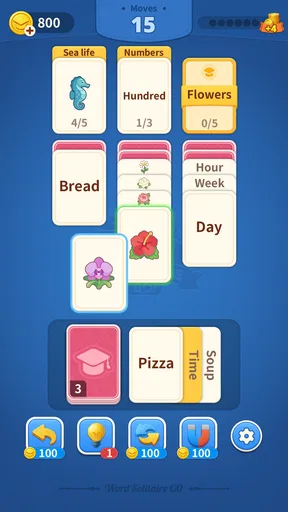
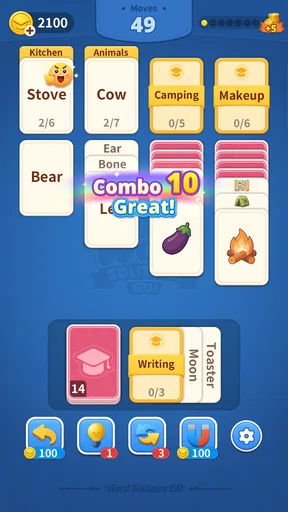
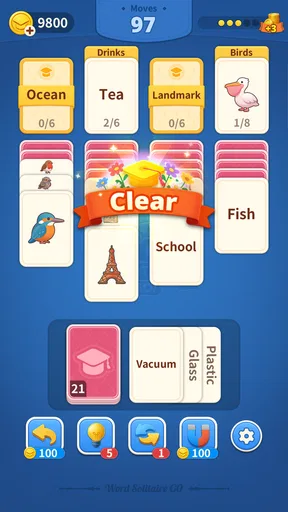
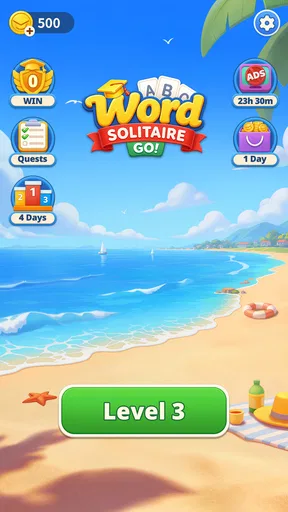
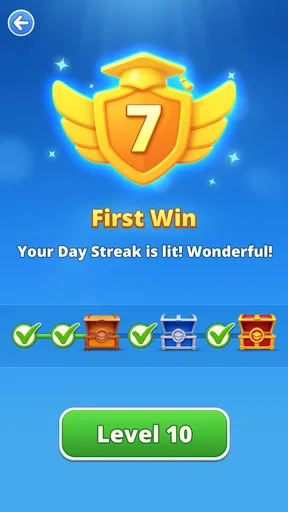

Our Review of Word Solitaire Go
 Analysis by Appyee
I spent time with Word Solitaire Go because its central idea is pleasantly focused: sort words, complete groups, and unwind through a solitaire-style word puzzle. That combination gives it a calmer rhythm than a typical timed word game. Instead of pushing me to find answers as quickly as possible, it encourages me to look at the available words, test relationships, and make a sequence of sensible choices.
That single capability—organizing words into meaningful groups—is what defines the experience. It sounds simple, but the appeal comes from the small decisions between an obvious match and a tempting wrong one. I found myself treating each board as a compact sorting problem rather than just a vocabulary test. For anyone who likes word games but does not always want a competitive or stressful session, this is an easy game to understand and a surprisingly relaxing one to return to.
Sorting words is the real heart of the game
Word Solitaire Go is a free word game from Nebula Studio, designed for Everyone and available for devices running Android 7.1 or later. Its store summary points to the basic loop, but the important detail is how that loop feels: the game turns word recognition into a solitaire-like sequence of choices. You are not merely forming a word from scattered letters. You are deciding which words belong together and when to commit to a group.
In my experience, that distinction makes the game more thoughtful than a conventional word scramble. A scramble usually rewards speed and immediate recognition. Here, I pay more attention to the board as a whole. One word may fit two possible ideas, while another seems unimportant until it reveals the intended group. The best moves often come from resisting the first attractive answer and checking whether it leaves the rest of the board in a workable state.
The strongest part of Word Solitaire Go is the balance between vocabulary and board management. Knowing words helps, but it is not the only skill involved. I also have to manage uncertainty, preserve useful options, and avoid using a flexible word too early. That gives the game a gentle strategic layer without making it feel like a complicated puzzle title.
Why the solitaire format changes the mood
The solitaire influence matters because it sets a slower pace. I can approach a board as a short mental break rather than as a contest against a clock. That makes it suitable for the moments when I want something interactive but not demanding: a quiet pause between tasks, a few minutes before bed, or a simple distraction while waiting.
This format also makes individual decisions feel more important. In a fast word game, a missed answer can disappear immediately. In a solitaire-style layout, the order of actions has more weight. I notice the consequences of choosing one group before another, especially when a word could support more than one interpretation. The game therefore rewards patience, not just a large vocabulary.
Players who enjoy arranging, categorizing, and spotting connections will probably understand the attraction quickly. The experience is less suitable for someone looking for elaborate story content, action, or a highly social competition. Its pleasure comes from the board in front of me and the satisfaction of making the structure clearer one decision at a time.
How I approach a difficult board
My most useful habit is to begin with the strongest relationships rather than the most unusual words. If several words clearly share a theme, I mentally mark that group but do not always select it immediately. I first inspect the remaining words for a second connection that might depend on one of those apparently obvious choices. This prevents a common mistake: completing a correct-looking group that uses a word needed elsewhere.
A second helpful approach is to separate certainty from possibility. I treat a group as reliable only when its members share a clear relationship and the leftover words also make sense. If a proposed group works only because I am stretching one word into an unusual meaning, I leave it open. That small pause is valuable in this kind of puzzle because an attractive interpretation can create a much harder board afterward.
I also try to identify the least flexible words. Some words naturally belong to many categories, while others have a narrow meaning. The narrow words are useful anchors. Once I find one, I can use it to test nearby possibilities instead of moving randomly. This is one of the more subtle strengths of the design: the game rewards the same kind of careful elimination that makes a physical solitaire puzzle satisfying.
When I get stuck, I do not keep staring at the same four-word relationship. I mentally remove the strongest group and reconsider the board that remains. That shift often exposes why the earlier uncertainty existed. Even without adding a new feature or rule, changing the order of thought makes the game feel more manageable and gives each round a small learning curve.
A realistic everyday use case
My favorite setting for Word Solitaire Go is a short break after finishing a concentrated task. I might have only a few minutes, so I do not want a game that requires a long campaign, a complicated setup, or a commitment to remember a story. A word board gives me an immediate goal. I can focus on a handful of relationships, finish a puzzle, and put the phone down without feeling that I have abandoned a larger session.
The game also fits a quieter evening routine. Because the core activity is sorting and solving rather than rapid tapping, it feels less agitating than many arcade-style alternatives. I still need to think, but the thinking is organized and contained. For me, that makes it a better choice than a competitive word ladder when I want to relax rather than measure my performance.
There is a practical tradeoff here. A short, self-contained puzzle can be convenient, but it may not provide the same sense of long-term progression as a game built around levels, collections, or a detailed achievement system. If your ideal mobile game is something you can develop over weeks through a visible campaign, this focused format may feel lightweight. If your priority is a repeatable mental exercise, that simplicity becomes an advantage.
What the current version offers as a starting point
The current release is version 1.1.0, and the game has already attracted over one hundred thousand installs. Its average rating is 4.9 from around two thousand eight hundred ratings, which suggests that the straightforward word-and-group concept is connecting with many players. I would not treat the rating alone as a guarantee that every board will suit every vocabulary level, but it does match my impression that the central loop is easy to appreciate.
The game is free to download, with optional in-app purchases ranging from ninety-nine cents to ninety-nine dollars and ninety-nine cents per item. That makes it accessible to curious players who want to try the puzzle style before spending anything. At the same time, anyone who dislikes optional purchases should check the purchase flow carefully and decide in advance whether they want to keep the experience entirely free.
Its Everyone content rating also makes it a reasonable choice for a broad household audience. I would still consider the individual player's reading ability and vocabulary, since the challenge comes from understanding word relationships rather than from age-specific content. Younger players may enjoy the sorting element, while adults may appreciate the calm, compact format.
Where the game feels strongest
The most convincing strength is the way the core mechanic turns familiar words into a visual reasoning task. I am not simply asking, “What word can I make?” I am asking, “Which words belong together, and what will this choice do to the rest of the board?” That second question gives the game more texture than its simple premise might suggest.
I also like that the format supports different playing styles. A confident player can move quickly through obvious groups. A cautious player can inspect the board and build a theory before committing. Neither approach requires a separate mode or an elaborate rules explanation. The same puzzle accommodates both, although the cautious approach is usually more reliable when a word has several plausible connections.
Another non-obvious benefit is that the game can help me notice how I categorize language. I sometimes assume two words belong together because they share a broad theme, only to realize that the intended relationship is narrower. That makes each mistake informative. The challenge is not only recalling vocabulary; it is recognizing the level of precision the puzzle expects.
Tradeoffs that may affect your decision
The same focus that makes Word Solitaire Go relaxing can also limit its appeal. Players who want fast action, dramatic presentation, or a strong multiplayer element will probably find it too quiet. This is a thinking game built around sorting, not a broad entertainment package. I would choose a more competitive word app when I wanted head-to-head pressure or a visible performance comparison.
It can also be frustrating when a board contains a word that feels compatible with several groups. That ambiguity is part of the challenge, but it can make a round feel less like a vocabulary test and more like an exercise in guessing the intended category. I found that taking a slower, elimination-based approach reduced this frustration, though it did not remove it completely.
The purchase range deserves a practical mention as well. The game costs nothing to start, but optional items can reach ninety-nine dollars and ninety-nine cents. For a casual player, the sensible approach is to enjoy the free portion first and avoid treating a difficult board as a reason to buy something immediately. The game works best when solving remains the main reward, not when progress becomes tied to spending.
There is also a difference between relaxing and mindless. Word Solitaire Go is calm, but it still asks me to concentrate. If I am exhausted and want something that requires almost no thought, a simple matching game may be a better fit. Conversely, if I find ordinary word searches too repetitive, the group-sorting decisions here provide more mental involvement without becoming overwhelming.
Who will gain the most from this word puzzle
I would recommend Word Solitaire Go to people who enjoy word association, categorization, and solitaire-like decision making. It is especially appealing if you want a game that can be started quickly, played in short sessions, and stopped without losing the sense of completion. The free entry point makes it easy to test whether the board style suits you.
It is also a good option for players who prefer private, self-paced challenges. You do not need to prepare for another person, wait for a match, or maintain a long session. I can play aggressively when the relationships are obvious or slow down when I want a more reflective puzzle. That flexibility is more valuable than it first appears on a phone.
On the other hand, I would steer competitive players toward a game with direct opponents, timed rounds, or stronger ranking systems. I would also suggest a different word title to anyone who mainly enjoys constructing words from letters, because the central satisfaction here comes from grouping existing words rather than maximizing letter combinations. The distinction is important: liking word games does not automatically mean liking this particular kind.
My final view after playing
Word Solitaire Go succeeds because it gives one idea enough room to work. Sorting words into groups sounds modest, yet the solitaire-style structure turns each choice into a small act of reasoning. I found the game most enjoyable when I treated it as a calm puzzle of elimination rather than rushing to claim the first group that looked possible.
Nebula Studio has created a focused word game with a broad age rating, a free starting point, and a clear identity. It is not the right replacement for a competitive word battle or a large progression-driven game, and the optional purchase range is worth keeping in mind. Still, for a quiet break, a short daily mental exercise, or anyone who likes finding order in language, it is an easy recommendation.
If you want a relaxed word puzzle where careful grouping matters more than speed, Word Solitaire Go is worth trying. Its best moments come when a messy board gradually becomes understandable, and that small feeling of order is exactly what keeps me coming back.
Privacy and Permissions
See what permissions an app requests and how it handles your data.
- Wi-Fi connection information
- view Wi-Fi connections
- Other
- view network connections, full network access, control vibration, prevent device from sleeping, Google Play license check
Verdict
Strengths of Word Solitaire Go
- Simple rules make it easy for new players to start quickly.
- Word challenges provide a relaxing alternative to traditional solitaire.
- Short rounds work well for quick breaks or casual play.
- Progression and daily goals add reasons to return regularly.
- Clean card-and-word gameplay is suitable for a wide range of ages.
Limitations of Word Solitaire Go
- Some puzzles may feel repetitive after extended play sessions.
- Difficulty can vary, making certain levels feel unexpectedly challenging.
- Hints or extra moves may be limited unless earned or purchased.
- Players seeking classic solitaire may miss traditional card layouts.
- Performance and available features can differ between Android and iOS devices.
Other Releases by Nebula Studio
View All


Similar Picks in This Category
View All
Word Search - Word Puzzle Game
Bluetile4.8

Word Search Quest - Puzzles
Blackout Lab4.8

CodyCross: Crossword Puzzles
Fanatee, Inc.4.7

Words of Wonders: Crossword
Fugo Games4.9

Wordscapes: Word puzzle game
PeopleFun4.7

Word Search Explorer
PlaySimple Games4.9
Frequently Asked Questions
What is Word Solitaire Go and how is the game played?
Word Solitaire Go combines classic solitaire-style card mechanics with word-building challenges. Instead of only arranging cards by suit, you use available letters and cards to create valid words and clear the board. Each level introduces a new layout, objective, or time limit, so the experience feels more varied than traditional solitaire. It is easy to understand, but later stages require planning and careful use of available moves.
Can I play Word Solitaire Go without an internet connection?
Word Solitaire Go may allow some previously loaded levels or basic gameplay to work offline, which is useful when traveling or when mobile data is unavailable. However, certain features can require an internet connection, including advertisements, cloud synchronization, events, leaderboards, updates, or in-app purchases. Offline availability may also vary depending on the version installed and the device, so it is best to launch the game once online before playing without connectivity.
Is Word Solitaire Go free to download and play?
Word Solitaire Go is generally available as a free download, but the free version may be supported by advertisements and optional in-app purchases. Players can often buy hints, extra moves, boosters, or other benefits, depending on the current version. You can usually progress without paying, although some levels may take more attempts or patience. Review the store listing and purchase settings before downloading, especially if children use the device.
Does Word Solitaire Go include hints, boosters, or difficult levels?
The game is designed to be approachable at the beginning, but its challenges normally become more demanding as you progress. Depending on the version, helpful tools such as hints, shuffles, extra moves, or boosters may be available when you are stuck. These features can make difficult boards more manageable, although they may be limited or connected to advertisements and purchases. Players who enjoy strategic puzzles should find the increasing difficulty engaging rather than overwhelming.
Is Word Solitaire Go suitable for children and casual players?
Word Solitaire Go can be a good choice for casual players because sessions are generally easy to start and do not require extensive gaming experience. Its word-based gameplay may also encourage vocabulary recognition and light strategic thinking. Parents should still check the app’s age rating, advertising, privacy information, and in-app purchase controls before allowing children to play. The suitability can vary according to the child’s reading ability and the language supported by the game.
Play our best games!


